
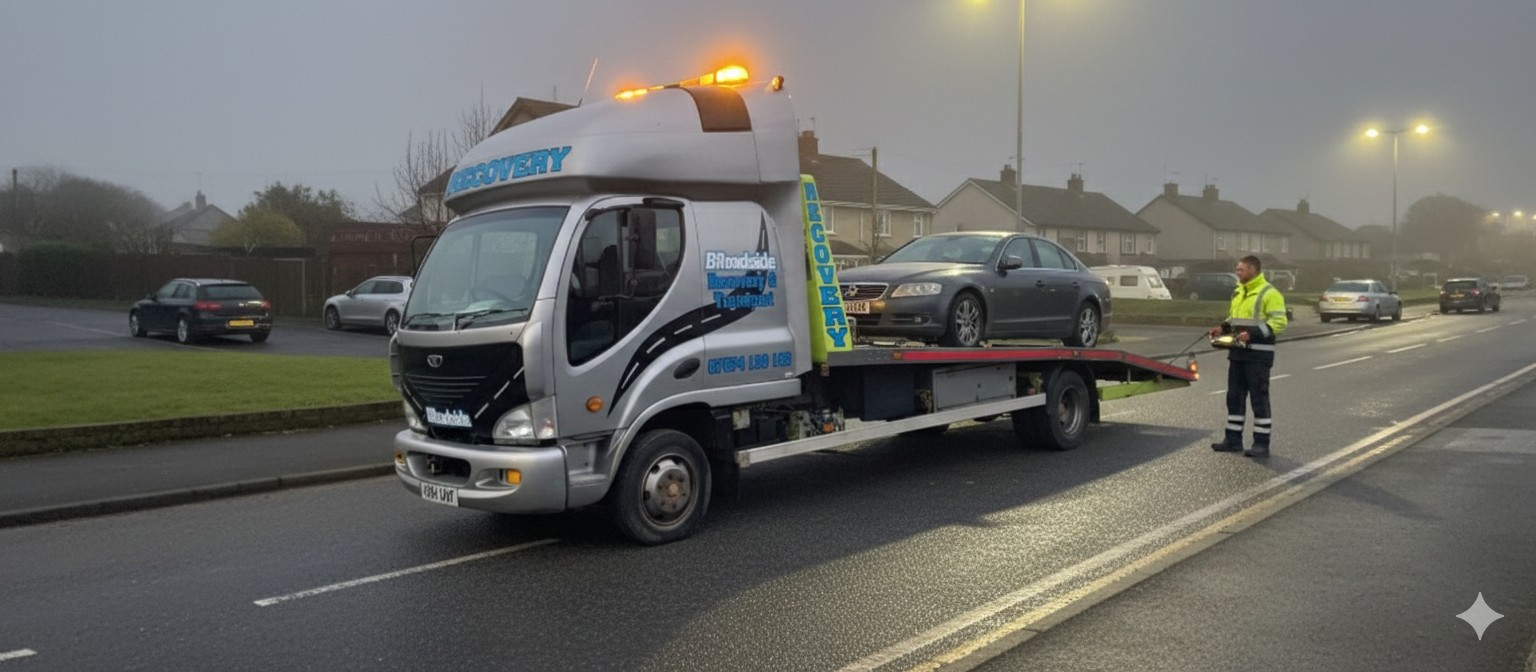
A breakdown on a fast road is one of the few genuinely dangerous situations most drivers ever face. Vehicles are passing at speed a few feet from where you are standing, and the priority stops being your car and starts being you.
This applies to the M5 into Devon, the A30 across Cornwall, and the A38 through Plymouth and the Tamar crossing — all fast, mostly dual-carriageway routes where the same rules matter, whether or not the road is officially a motorway.
Read this once while calm, because it is not something you want to be working out for the first time with lorries going past at seventy.
Get off the carriageway if you possibly can
If the vehicle still moves and steers, even limping, your job is to get it as far left as possible: onto the hard shoulder where one exists, into an emergency refuge area on a smart section, or past the barrier onto the verge on an all-lane-running stretch if there is nowhere else.
Indicate left early, slow down gradually rather than braking hard, and aim to stop as close to the nearside edge as you can, ideally near a marker post so your location can be given precisely.
- Hazard lights on the moment you suspect a problem, not after you have stopped
- Steer left decisively — do not wait to see if the fault clears itself
- Stop parallel to the verge, wheels turned away from the carriageway if on a slope
- Switch off the engine once stopped
- Do not attempt any repair yourself at the roadside
Getting out safely
Once stopped, everyone gets out through the doors on the side away from the traffic — the left-hand, nearside doors — and moves well behind the safety barrier if one is present. This applies even in poor weather or the dark; staying in the vehicle is far riskier than being cold and wet.
Take a torch or a phone light if you have one, wear something light or reflective if it is dark, and do not cross the carriageway on foot for any reason, including to reach an SOS phone on the other side.
- Children and pets out first, on the nearside, kept close and well back from the road
- Do not stand between your vehicle and the traffic, even to wait for help
- Do not attempt to change a wheel or open the bonnet at the roadside on a fast road
- Keep your seatbelt on if you cannot get out safely — this is rare but can happen on a hard shoulder in heavy traffic
Smart motorways and lane closures
Sections of some motorways run without a permanent hard shoulder, using overhead gantries to close lanes with a red X when there is an obstruction. If you break down in a live lane on one of these sections and cannot reach a refuge area, put your hazards on immediately and get out on the nearside if it is safe to do so, moving behind any barrier.
If you are stuck in a live lane and cannot safely leave the vehicle, keep your seatbelt fastened, hazards on, and call 999 as soon as you can — this is treated as an emergency, not a routine breakdown.
- Emergency refuge areas are marked with blue signs and an orange SOS phone
- A red X on an overhead gantry means the lane is closed — never drive in it
- Radar-based systems can detect a stopped vehicle in a live lane, but do not rely on this to keep you safe
Using the orange SOS phones
The orange phones set at regular intervals along the hard shoulder or in refuge areas connect directly to National Highways and, on the far side, put you through to police or the relevant control room. They know your exact location the moment you pick up, which removes any guesswork about where you are.
If there is no SOS phone within safe reach, or you are on the M5 outside Cornwall on a stretch without one nearby, a mobile call to 999 or 101 works just as well — give your location as precisely as you can, using a marker post number if you can see one.
- Face the traffic while using the phone if there is no barrier to stand behind
- State whether anyone is injured or in immediate danger
- Give the marker post number visible on the nearest post if you have one
What to tell the operator or recovery firm
Whether you are speaking to National Highways, the police or us directly, the same details get help to you fastest: your exact location including direction of travel and the nearest junction or marker post, your vehicle's make, colour and registration, how many people are with you, and whether anyone needs medical attention.
Also say whether you are in a refuge area, on a hard shoulder, or unable to leave a live lane — that single detail changes how urgently the response is treated and who attends first.
- Direction of travel and nearest junction number
- Marker post number if visible
- Number of people and any children or pets in the vehicle
- Whether the vehicle is in a live lane or safely off it
After you are safe
Once you and any passengers are clear of the carriageway, stay together, stay visible, and wait where you can see the road without standing near it. Do not return to the vehicle for belongings until recovery arrives and tells you it is safe to do so.
A recovery vehicle attending a live carriageway will usually approach with its own beacons on and position itself to shield the work from oncoming traffic before anyone goes near your car again.
Need this sorted today?
Stranded on the A30, A38 or M5 corridor? Get yourself safe first, then call us and we'll get a truck moving to you.
Frequently asked questions
Should I put out a warning triangle on the motorway?
No. Warning triangles must never be used on a motorway or fast dual carriageway — walking back into live traffic to place one is far more dangerous than leaving your hazards on and getting clear of the road.
Is it safe to stay in my car on the hard shoulder?
It is safer to get out and stand behind a barrier or well up the verge, away from passing traffic, than to remain inside the vehicle, which can be struck from behind. Exceptions are rare, such as being unable to open a door safely, in which case keep your seatbelt on and hazards flashing.
What if I break down in a live lane with no hard shoulder?
Keep your hazards on, stay belted in if you cannot get out safely, and call 999 immediately rather than waiting. Only leave the vehicle if you can do so on the nearside without stepping into a live lane.
Can Broadside Recovery collect from a motorway hard shoulder?
Yes, we recover from the A30, A38 and M5 corridor, working alongside the emergency services' instructions where they are in attendance. Tell us your marker post or junction details when you call so the truck can be positioned safely.
How do I know if I am on a smart motorway section?
Overhead gantries with lane-status signals and reduced or absent hard shoulder are the main signs. If in doubt, treat any fast dual carriageway with the same caution — get left, get out, get behind a barrier.
Services covered in this guide
Related guides
What Happens When You Call
The full call-out sequence from first ring to drop-off, including exactly what to do while you wait at the roadside.
ReadBreakdown Emergency Kit
A practical, no-nonsense list of what is actually worth carrying for a breakdown, and the rules around using it safely once you need it.
ReadHow to Choose a Recovery Service
The practical checks worth doing before a breakdown happens, so the number you dial is one you can trust rather than the first search result.
Read