
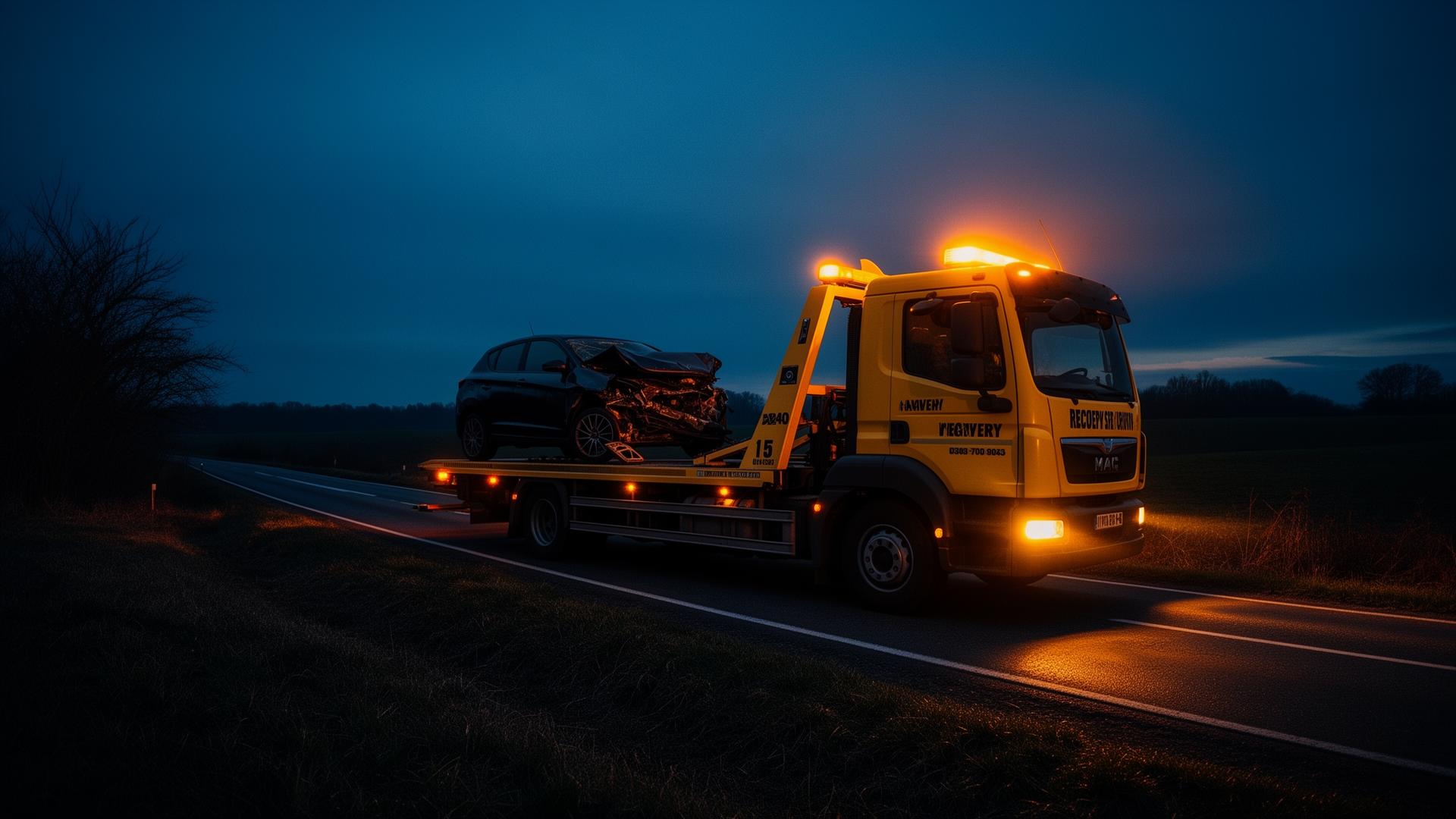
A large part of Cornwall's road network is single-track lane bounded by stone-faced hedgebanks, with passing places rather than verges and no room whatsoever to turn a recovery truck.
Add wet granite, a steep gradient down to a cove, and a satnav that treats a farm track as a through road, and you have the county's most common awkward recovery.
Why lanes are harder than they look
Cornish hedges are earth-and-stone structures, not vegetation. Clipping one damages the vehicle, not the hedge. That removes the margin a recovery truck would normally use.
Gradients compound it: many lanes to coves and harbours drop sharply with a tight turn at the bottom, and a loaded flatbed needs far more room than the car that got itself down there.
How we approach it
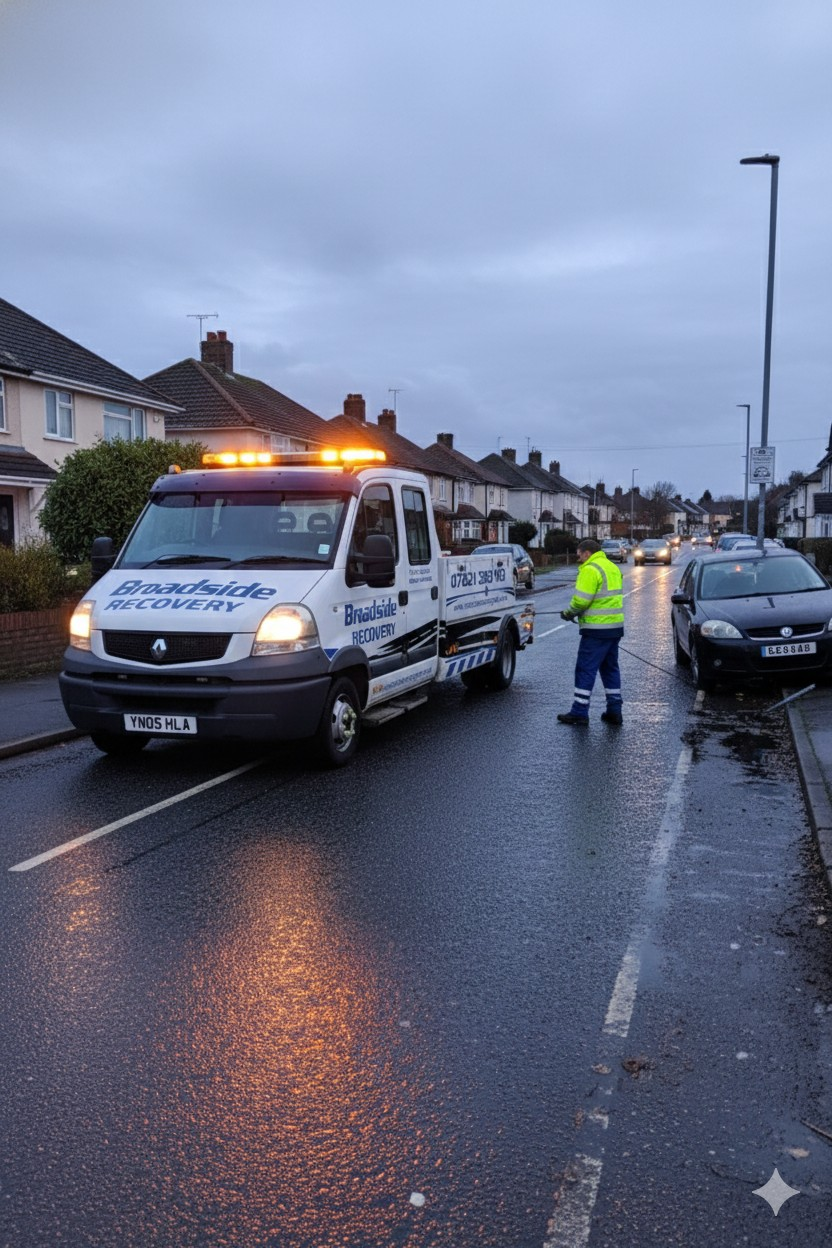
The plan is usually to bring the vehicle to the truck rather than the truck to the vehicle. That can mean a winch pull to a passing place, a careful reverse to a field gateway or junction, or loading at the nearest point with genuine turning room.
Where the lane is genuinely impassable for a flatbed, the extraction is staged — move the vehicle to a viable loading point first, then load.
What to tell us on the call
- Is the lane single-track, and are there passing places?
- How far are you from the nearest wider road or junction?
- Is there a field gate, farm entrance or car park nearby?
- What is the surface — tarmac, gravel, mud, grass?
- Is there a gradient, and which way is the vehicle facing?
- Are there overhanging trees or a low branch line?
Wedged, grounded or in the hedge
If you have grounded on a crest, dropped a wheel off the edge or slid into the bank, stop trying to drive out. Repeated attempts usually dig in further and add damage.
Leave the vehicle where it is, get people out to a safe spot where they can be seen, and describe the position accurately. A controlled winch out is quicker than an hour of wheel-spinning.
Need this sorted today?
Down a lane and stuck? Describe the access and we will plan the extraction before we roll.
Frequently asked questions
Can a recovery truck get down a single-track lane?
Often, yes — but where there is no turning room the usual method is to winch or move your vehicle out to a wider point and load it there. Describe the lane and we will plan the approach before setting off.
My car is wedged against the hedge. Should I try to drive out?
No. Repeated attempts normally worsen the damage and dig the car in. Stop, get everyone somewhere safe and visible, and let it be winched out under control.
What if my satnav has sent me down a farm track?
It happens constantly here. Note the last named road or junction you passed and, if you can, get a what3words address — track locations are otherwise very hard to describe accurately.
Do you recover from beach and cove car parks?
Yes, subject to height barriers, surface and tide where relevant. Tell us about any barrier and the surface condition when you call.
Services covered in this guide
Related guides
Broken Down on the A30
The A30 is the county's spine and its fastest road. Here is the safe sequence if you stop on it.
ReadWhat Happens When You Call
The full call-out sequence from first ring to drop-off, including exactly what to do while you wait at the roadside.
ReadBreaking Down on Holiday
Unfamiliar roads, no local knowledge and a booking to get to — the practical version for visitors.
Read