
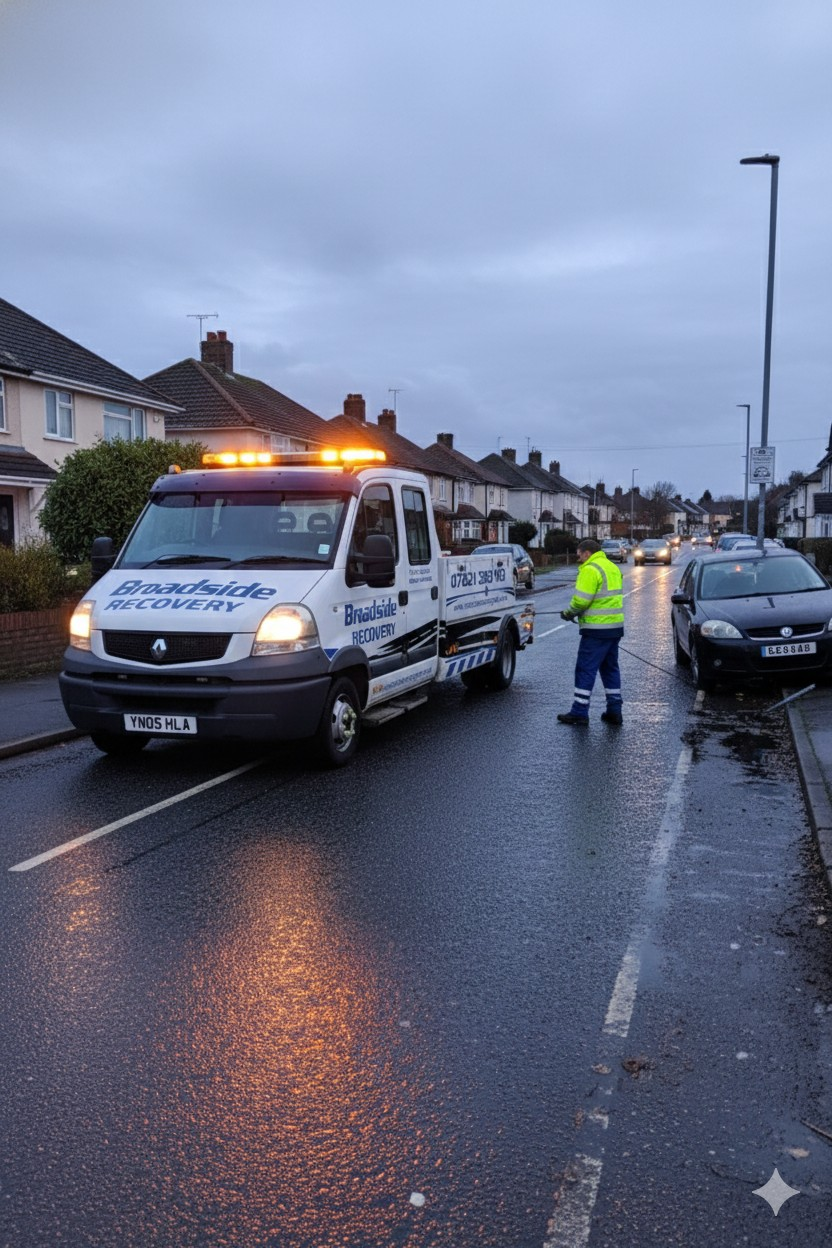
If you have broken down on the A30, get everyone out through the verge-side doors, stand behind the barrier or well up the bank, and switch the hazards on. Then note your direction and the last junction you passed, and call Broadside Recovery on 07874 130193, 24/7.
The A30 runs the length of Cornwall from the Devon border down to Penzance, switching between dual carriageway and single carriageway as it goes. It carries the bulk of the county's through traffic and, in summer, a very large volume of unfamiliar drivers.
A breakdown here is more dangerous than one in town, because closing speeds are high and there is often no hard shoulder on the single-carriageway sections. The priority order is people, then position, then the vehicle.
First 60 seconds
Do these in order:
- Hazards on immediately, even before you have stopped
- Get as far left as you can — a layby, a slip road, a verge, an emergency area
- Do not attempt to cross the carriageway on foot
- Everyone out through the nearside doors and behind the barrier or up the bank, uphill of the vehicle where possible
- Do not stay inside the vehicle on a live carriageway unless leaving it would be more dangerous
- Then call — recovery, and 999 if you are in a live lane or anyone is hurt
How to describe where you are
The A30 has few obvious landmarks at speed, so exact location matters more here than anywhere else in the county. Use, in order of usefulness: a what3words address, a driver location sign, the last named junction you passed, and your direction of travel.
Direction is critical. Eastbound near Chiverton and westbound near Chiverton are separated by a barrier and can mean a several-mile detour for the truck.
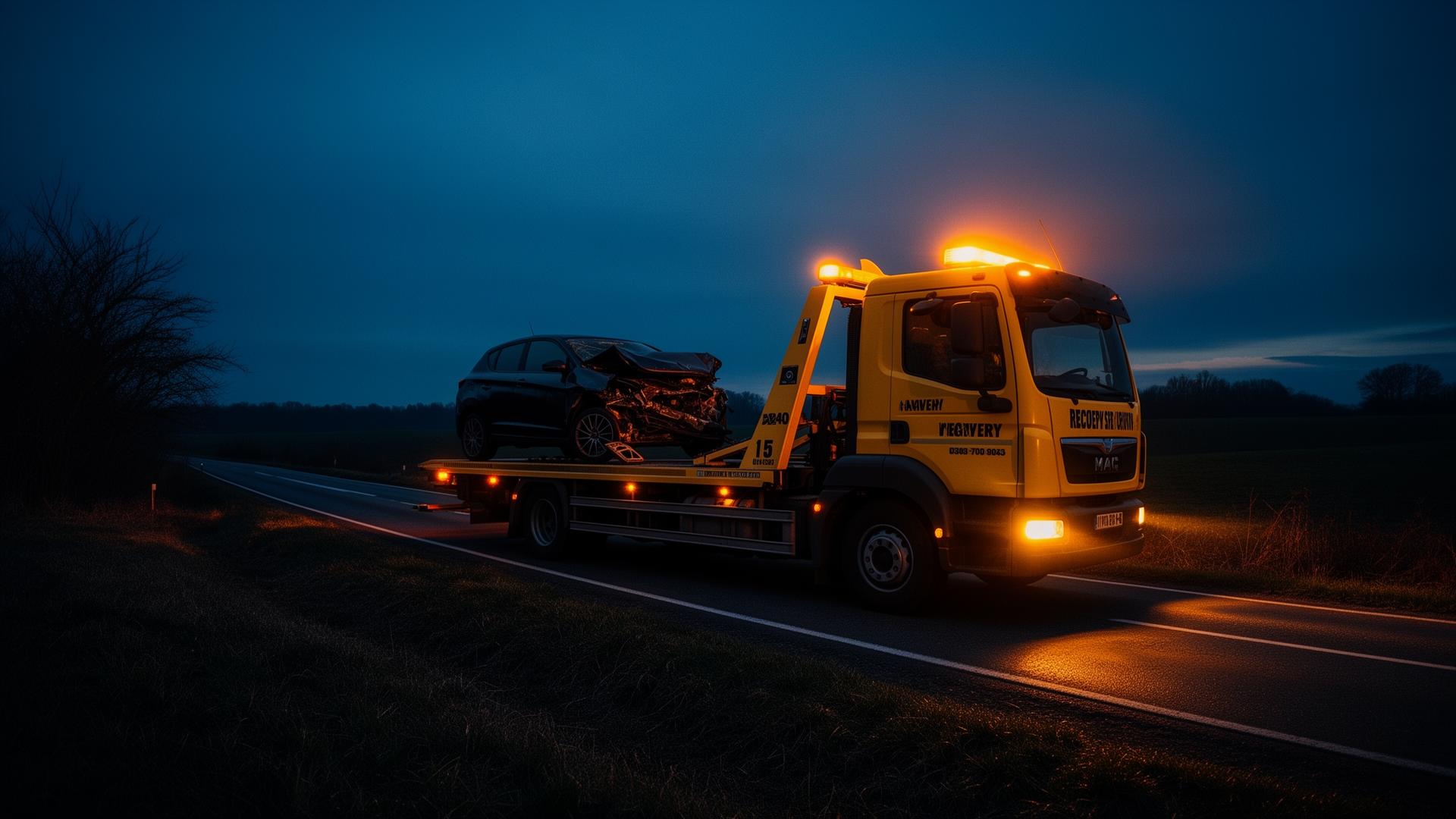
Recovery on a fast road
Loading on a live A-road is done with the truck positioned to shield the working area, and it is deliberately methodical. If the vehicle is in a hazardous position, the first move may be a short winch or drag to a safer spot before proper loading begins.
Where the police or National Highways are already on scene, their instructions take priority and the recovery works around the traffic management in place.
Common A30 breakdowns
Sustained high-speed running exposes cooling and belt faults, and the long climbs either side of Bodmin Moor are hard on an already marginal cooling system. Tyre failures are common on the fast sections, and running out of fuel is a recurring problem on the stretch west of Bodmin where filling stations are spaced out.
If you suspect overheating, stopping early at a layby is far better than pressing on to the next junction.
The information that gets a truck to you quickly
On a dual carriageway a postcode can put you on the wrong side. Direction of travel, the last junction, and any nearby marker post, bridge or lay-by are what we need to find you.
If the vehicle will still move safely, leave at the next junction rather than stopping on the carriageway. Loading from a slip road, lay-by or side road is quicker and much safer for everyone.
Related pages
Need this sorted today?
Stopped on the A30 now? Get safe behind the barrier, then call us with your direction of travel.
Frequently asked questions
Should I stay in my car on the A30?
On a live carriageway or a section without a hard shoulder, no. Get out through the nearside doors and stand behind the barrier or up the bank, away from and preferably uphill of the vehicle. Stay inside only if getting out would put you in more danger.
How do I tell you exactly where I am on the A30?
A what3words address is best, followed by a driver location sign, then the last junction you passed plus your direction of travel. Direction matters enormously on the dual sections — the two carriageways are not interchangeable.
Can you recover from the A30 at night?
Yes. We operate 24/7, and the A30 is one of the routes we work most often. Night jobs on the dual sections are worked with the truck positioned to protect the scene.
What if I have run out of fuel on the A30?
Do not walk along the carriageway to a filling station. Get to a safe position off the road and call — a fuel drop as roadside assistance is usually faster and always safer than walking a fast A-road.
Do you cover the A30 across Bodmin Moor?
Yes. On the moor, phone signal drops in places, so send your location as soon as you have a signal and tell us your direction.
My car is still limping along the A30. Should I stop?
If it will still move safely, carry on to the next junction and stop there. Loading from a slip road or lay-by is quicker and safer than on the carriageway.
Services covered in this guide
Related guides
How Long Does Recovery Take?
There is no single number for a recovery job. The total is three separate waits added together, and you can influence two of them.
ReadWhat Happens When You Call
The full call-out sequence from first ring to drop-off, including exactly what to do while you wait at the roadside.
ReadRun Out of Fuel
Why a fuel drop beats walking, and the extra step diesel drivers usually need.
ReadRecovery in Narrow Cornish Lanes
Cornwall's lanes are the county's defining recovery challenge. Here is how a truck actually gets to you.
Read