
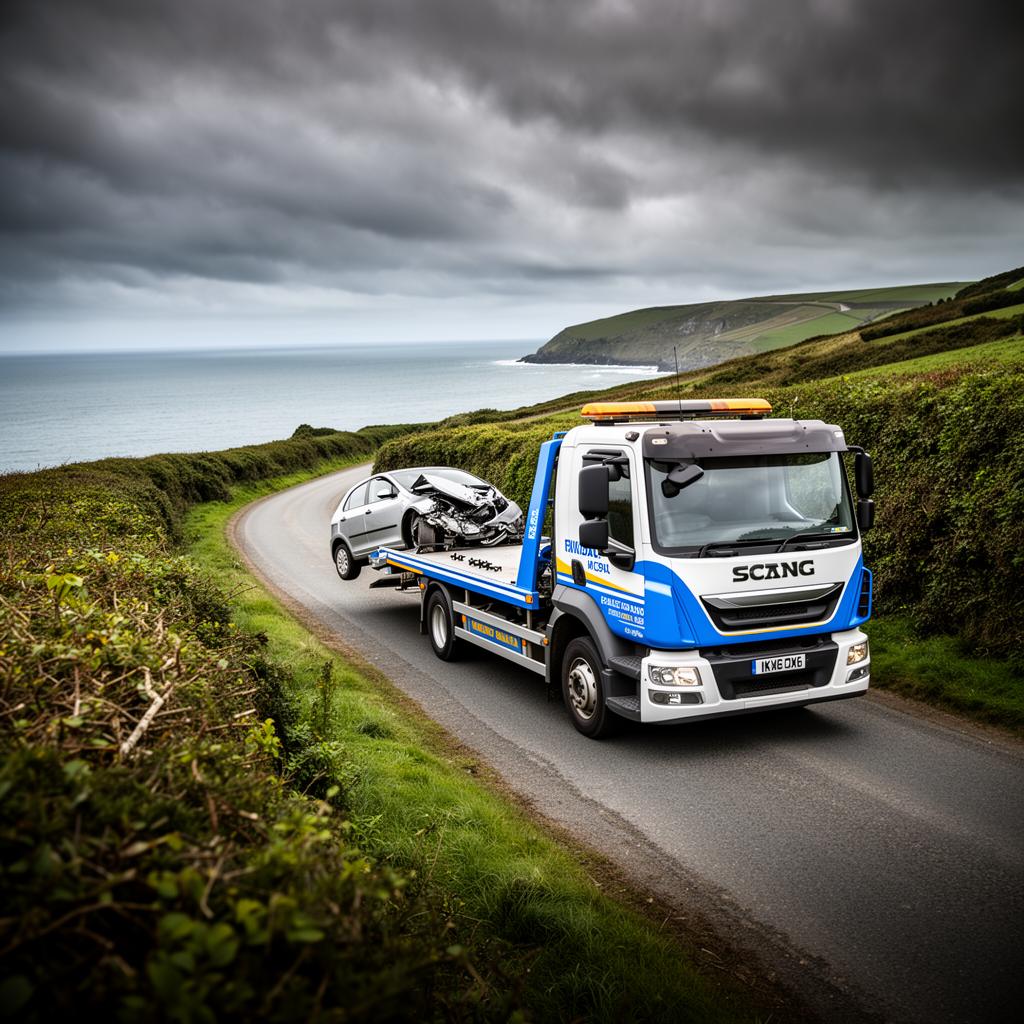
The short answer: if the car cannot be driven safely, the most reliable way to move it is on the back of a flatbed, with all wheels off the ground, straight to the garage you have chosen. Pushing it down the road, towing it behind a friend's car or limping it there on a warning light are the three methods most likely to turn a repair bill into a bigger one.
This guide is for the less dramatic breakdown — the car that would not start on Monday morning, the one that died in the supermarket car park, the vehicle that has been sitting on the drive since the clutch went. There is no traffic rushing past, so the pressure is different. That calm is useful: it gives you time to book the garage first, gather the details a recovery driver needs and avoid paying twice.
Step one: ring the garage before you move anything
Garages in Cornwall are often busy, and many will not accept a non-running vehicle without warning because it has to be parked somewhere until a ramp is free. Call ahead, tell them the car is coming in on a recovery truck, and ask where they want it left and whether anyone will be there to take the keys. If it will arrive out of hours, ask whether there is a key drop.
Having that answer before you book recovery means the driver can deliver it once, to the right place, rather than waiting at a locked gate.
Your realistic options
Each option suits a different situation. Be honest with yourself about which one you are in.
- Minor fault, car otherwise healthy: roadside assistance may get it running well enough to drive to the garage yourself, for example after a flat battery or a flat tyre.
- Car will not start or is unsafe to drive: flatbed recovery from where it sits to the garage door.
- Car does not roll — seized brakes, locked steering, no keys, flat tyres: still a flatbed job, with skates, dollies or a winch used to get it onto the bed.
- Non-urgent move, for example a car that has been off the road for months: book a vehicle transport slot rather than an emergency call-out.
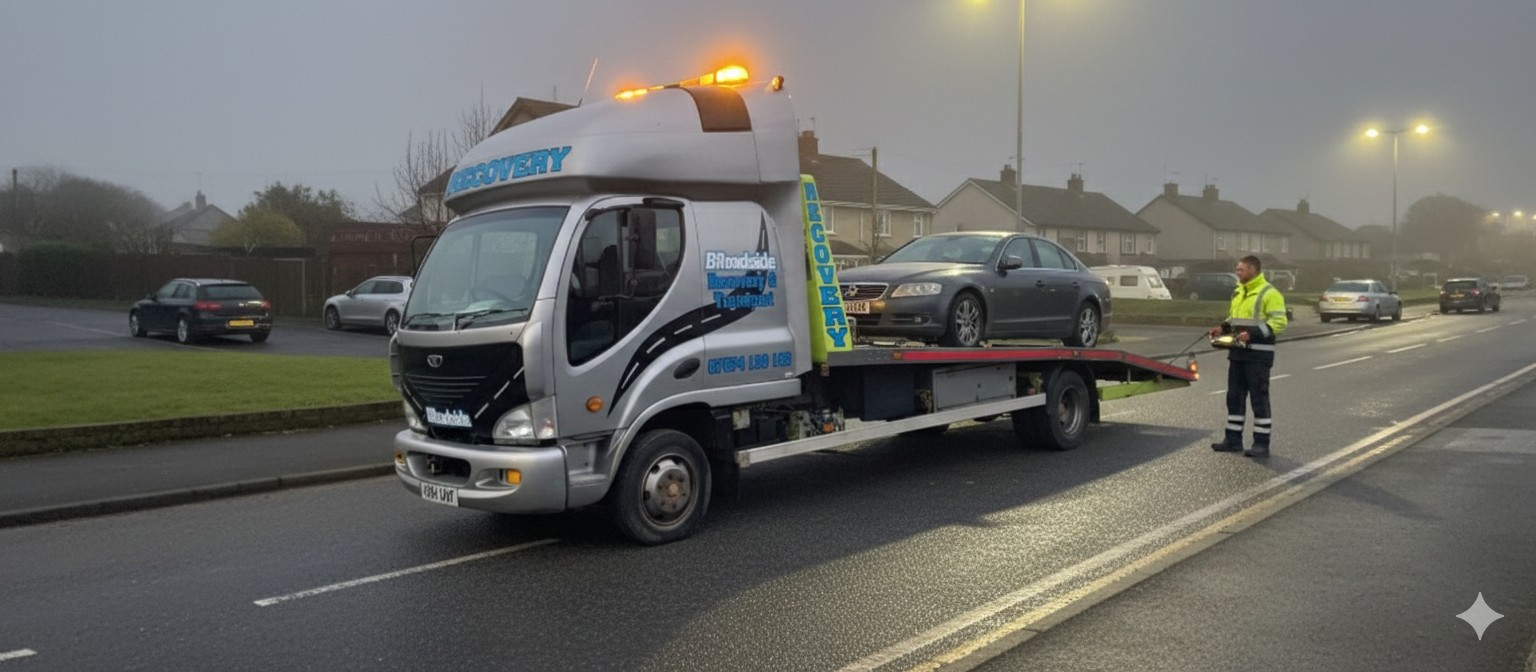
Why pushing or towing it yourself is a false economy
Pushing a car along a public road is harder and more dangerous than it looks, particularly on Cornish hills where a car can run away from the people pushing it. Steering and brakes feel very different without the engine running, and on many modern cars the steering can lock.
Towing a broken-down car behind another car with a rope or strap needs a competent driver in the towed car, working brakes and steering, and a route with no steep descents. Automatic gearboxes, four-wheel-drive systems and electric vehicles can be damaged by being pulled along with wheels turning. A flatbed avoids all of that, because nothing on the vehicle rotates while it travels.
What to tell us when you call
A quick, accurate description saves time on the day. When you ring Broadside Recovery on 07874 130193, have these ready:
- Exactly where the vehicle is — the address, and where on the property or in the car park.
- Make, model and whether it is a car, van, 4x4 or something heavier (we move vehicles up to 7.5 tonnes).
- Whether it starts, rolls, steers and brakes, and whether you have the keys.
- Anything awkward about access: a low barrier, a narrow lane, a steep drive, a multi-storey.
- The garage's name and address, and whether they are expecting it.
Parked in a car park or on the street
Multi-storey and underground car parks can have height limits a recovery truck cannot pass, so mention the car park by name. If the car is in a bay on a slope or tight to a wall, it may need winching out or moving on skates before it can be loaded. Street parking is usually straightforward, but let us know if there are restrictions that mean the vehicle must be moved by a certain time.
Price and timing
You do not need AA, RAC, Green Flag or any membership to use us. We agree the price on the phone before we set off, so there are no surprises when the truck arrives. The things that change the cost of a garage move are the distance, whether the vehicle rolls, how awkward it is to reach and the time of day. If the car is safe where it is and the garage cannot take it until tomorrow, a booked move is usually simpler than an emergency call-out.
If it cannot wait — the car is blocking a driveway, or you need it at the garage first thing — we operate 24/7, so ring and we will talk through what is possible.
Need this sorted today?
Car stuck at home or in a car park and needs to reach a garage? Call with the address, the garage and whether it rolls, and we will quote before we set off.
Frequently asked questions
Can you take my car from my home to a garage?
Yes. We collect from driveways, streets, car parks and workplaces across Cornwall and deliver to the garage you choose. Tell the garage it is coming first.
Do I need to be there when the car is collected?
It is best if you are, so the driver can check the vehicle and take the keys. If not, discuss key arrangements with us when you book.
My car has been on the drive for months. Is that an emergency call-out?
Usually not. A vehicle that is safe where it is can be moved as a booked transport job, planned around the garage's availability.
Can you move it if the steering is locked or there are no keys?
Usually, yes. A vehicle that will not roll or steer can be moved on skates or dollies and winched onto the flatbed. Say so when you call so the right equipment comes.
Services covered in this guide
Related guides
When a Car Won't Roll: Skates, Dollies and Winching
Some vehicles cannot simply be pushed onto a truck. Here is how immovable cars are recovered without damage, and why the details you give on the phone matter.
ReadMoving a Non-Runner
Seized, keyless, wheel-less or simply dead — how each type of non-runner is actually loaded.
ReadFlatbed vs Tow Truck
Why the wrong lift can damage a gearbox or bumper, and how to tell which method your vehicle actually needs before the truck arrives.
ReadCar Will Not Start, What Is Actually Wrong
The noise the car makes when you turn the key narrows it down faster than anything else. Here is how to read it.
Read