
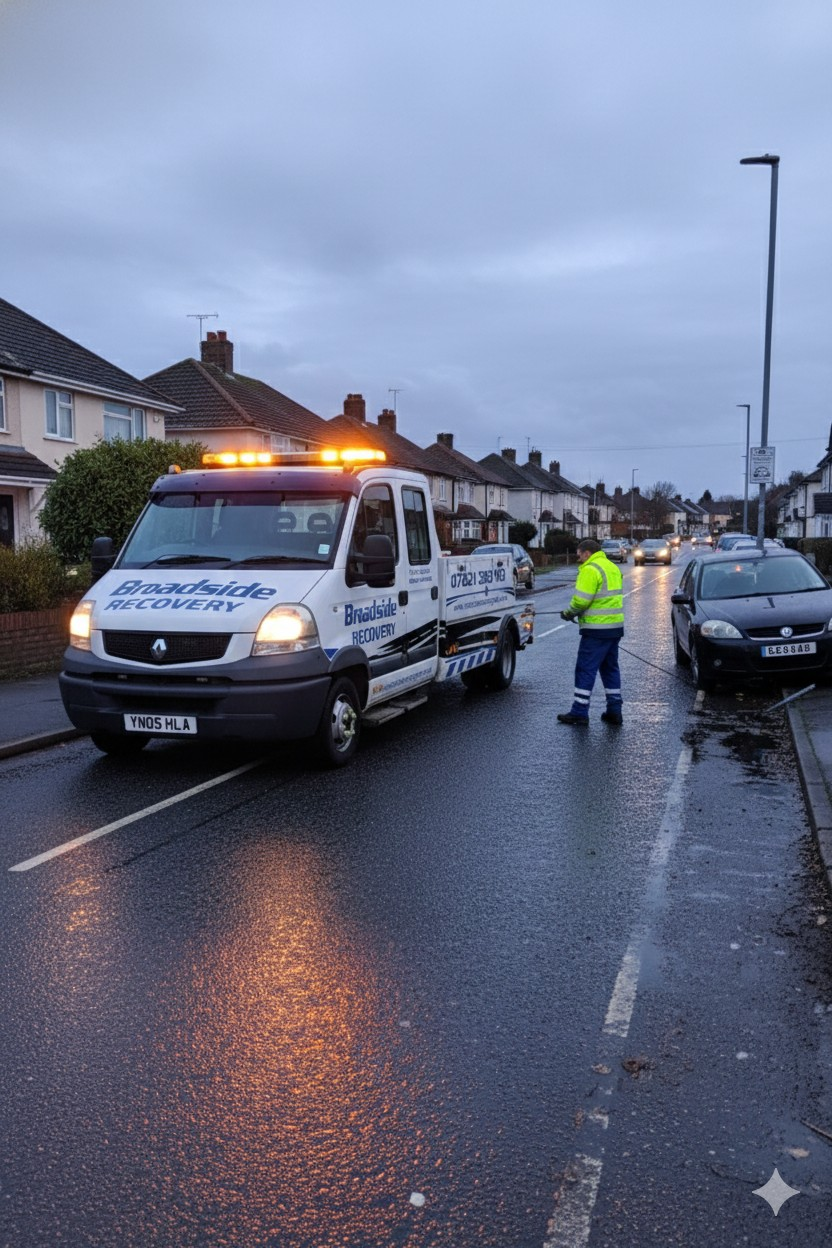
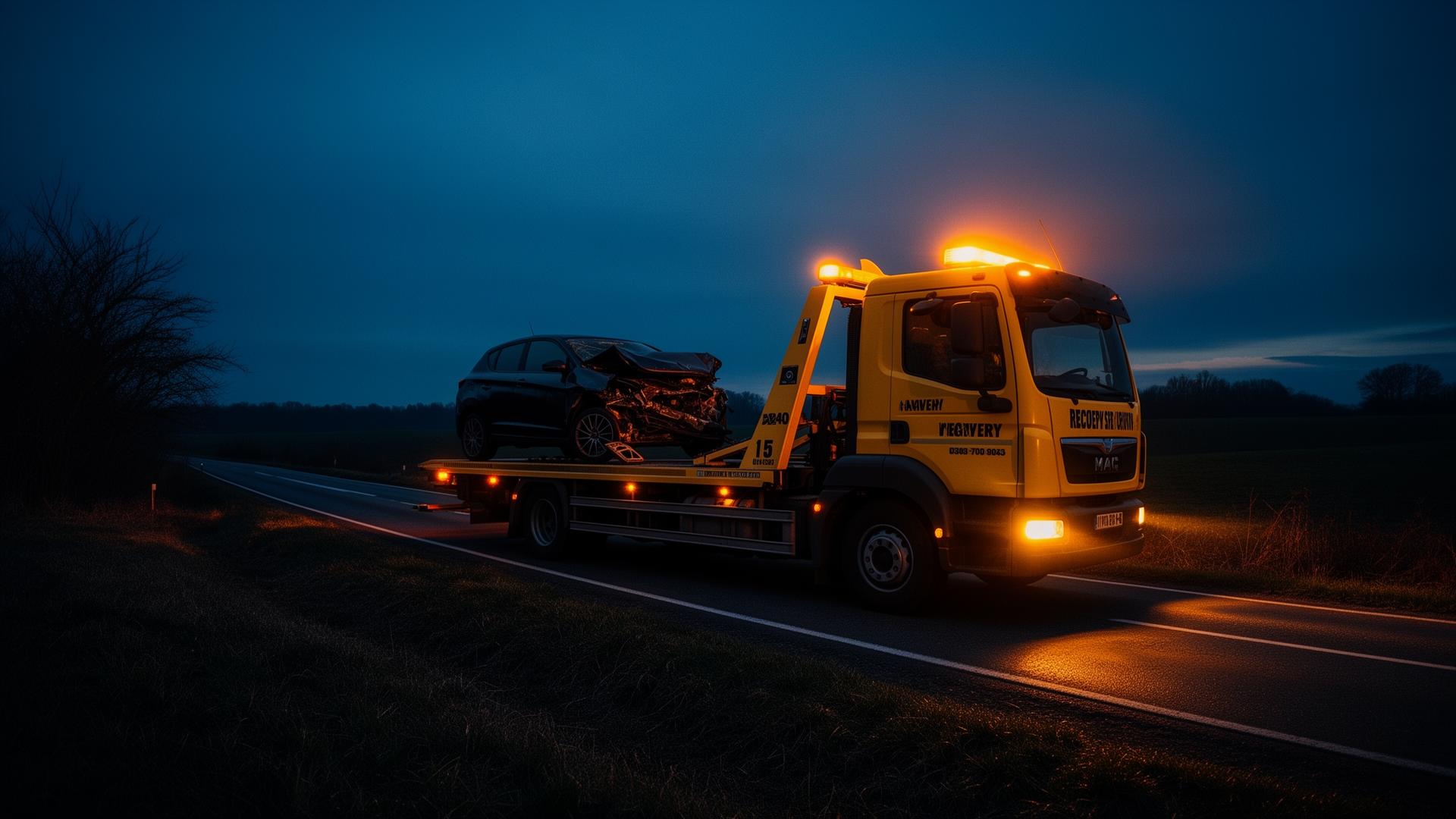
Flatbed towing carries the whole vehicle on the truck bed with all four wheels off the road, so nothing turns on the drivetrain. It is the safer choice for automatics, 4x4s, electric vehicles, low cars and anything with damage underneath. A conventional tow leaves two wheels on the road.
"Tow truck" is what most people say, but the majority of modern recoveries are done on a flatbed — the vehicle is winched up onto a tilting bed and travels with all four wheels off the ground.
The difference is not cosmetic. Choosing the wrong method on the wrong vehicle can damage a gearbox, a transfer case or a low front bumper. Here is how the two compare.
How a flatbed works
The bed tilts and slides back to ground level, the vehicle is winched or driven on, and it is then strapped down at the wheels or chassis points. Nothing rotates during the journey and nothing is under tension.
This is the default for anything with an automatic gearbox, four-wheel drive, air suspension, an electric drivetrain, or accident damage — and for anything low, valuable or unusual.
When a conventional tow still makes sense
A spec lift or suspended tow lifts one axle and lets the other roll. It can be quicker to hook up and is workable for short repositioning moves on straightforward front-wheel-drive manual cars where the rolling axle is undamaged.
It is the wrong choice where the rolling wheels are locked, where the drivetrain cannot freewheel, or where the vehicle has to travel any real distance.
Side by side
- Damage risk — flatbed is lowest; nothing rotates and nothing drags
- Automatics and 4x4s — flatbed only, unless the manufacturer explicitly permits a towed axle
- Electric and hybrid vehicles — flatbed only; a rolling driven axle can generate current
- Low or modified cars — flatbed with extended ramps
- Very short repositioning of a rolling manual car — a conventional lift can be adequate
- Off-road or embedded vehicles — winch first onto hard standing, then flatbed
What we run
Broadside Recovery operates flatbed recovery for cars, vans and light commercials up to 7.5 tons, which means the same method covers a supermini and a long-wheelbase van. If your vehicle needs winching before it can be loaded, that is handled on the same call-out rather than a second visit.
Why we use a flatbed for most jobs
With nothing rolling on the road, there is no risk of a gearbox, transfer box or motor being turned while the engine is off. That matters most for automatics and EVs, where towing on driven wheels can cause expensive damage.
A flatbed also handles accident damage well, because a bent wheel or broken suspension does not have to carry weight on the journey. Tell us about any damage on the call so the loading is planned properly.
Related pages
Need this sorted today?
Not sure which method your vehicle needs? Describe it on the phone and we will tell you straight.
Frequently asked questions
Can an automatic car be towed with two wheels on the ground?
As a rule, no. Most automatic gearboxes rely on the engine running to circulate fluid, so rotating the driven wheels without it can damage internals. A flatbed removes that risk entirely, which is why it is the default for automatics.
Is a flatbed always more expensive?
Not necessarily. Because a flatbed handles almost every scenario in one visit — including winching a non-roller on — it often avoids the extra time and equipment a conventional tow would need to make the same job safe.
My car is very low. Will it ground on the ramps?
Tell us the vehicle and ride height when you call. Low vehicles are loaded using a shallower approach angle and, where needed, ramp extensions, so the front lip and undertray clear the bed edge.
Can a flatbed reach my vehicle down a narrow lane?
Often, but not always. If access is tight we may winch the vehicle out to a wider point before loading. Describe the lane, any passing places and the surface when you call and we will plan the approach.
Is flatbed towing safe for an electric car?
Yes, and it is the right method. EVs should not be towed with driven wheels on the ground, so we load them fully onto the bed.
Can you flatbed a van?
Yes. We carry cars, vans and light trucks up to 7.5 tons. Give us the plated weight and we will send the right truck.
Services covered in this guide
Related guides
Towing an Automatic Car
Many automatics should not be towed with their driven wheels on the road. Loading onto a flatbed avoids the problem entirely.
ReadTowing Eyes & Recovery Points
Two minutes of checking before the truck arrives can prevent a bent subframe or a torn bumper.
ReadElectric Vehicle Recovery
EVs cannot be conventionally towed. Here is why, plus what to do if you run flat between chargers in Cornwall.
Read3.5 Ton vs 7.5 Ton Recovery
One number on your V5 decides which truck comes. Here is where to find it and why it matters.
Read