

Cornwall sits exposed to Atlantic weather, and winter storms regularly bring heavy rain, flooded low points and, in coastal towns, seawater pushed inland by surge and high tide together. Roads that are fine on a normal day can become genuinely dangerous within an hour of a storm setting in.
The single most common mistake is misjudging standing water — it looks shallow, it usually is not, and the cost of getting it wrong ranges from a stalled engine to a car being swept sideways off the road. This guide covers what to look out for and, just as importantly, when to simply not attempt it.
None of this is about scaring drivers off the road unnecessarily. Most Cornish storms pass without incident for anyone who takes a few sensible precautions and is willing to turn back when a route looks wrong.
Standing water — the depth trap
Water on a road is almost always deeper than it looks, particularly at night or in rain when visibility is poor and there is no clear reference point for depth. A dip that seems like a puddle can be over a foot deep once you are into it, especially where a road crosses a natural low point or a stream has overflowed.
As a rough guide, most cars start to struggle in water around the depth of the door sills, and even a shallower depth taken at speed can push water into places it should never reach, including the engine's air intake.
- If you cannot see the road surface through the water, do not assume you know how deep it is
- Watch for other vehicles — if a car ahead struggles or stalls, do not follow the same line
- Fast-flowing water is far more dangerous than still water of the same depth
- It only takes a modest depth of moving water to float or push a car sideways
Fords and low-lying lanes
Cornwall has a number of fords and low crossing points on minor roads that flood quickly after heavy rain and can rise or fall within an hour. Depth markers are provided at many fords for a reason — read them before committing, not after you are already in the water.
A ford that was passable an hour ago is not guaranteed to still be passable now, particularly during a storm when rainfall upstream can raise levels faster than is obvious from where you are standing.
- Check depth markers where fitted, and treat any reading above a few inches as a reason to turn back for most cars
- Levels can change quickly during and after heavy rain — do not assume an earlier crossing is still valid
- If in doubt, find the alternative route rather than risk the ford
Saltwater flooding on the coast
In coastal towns, storm surge combined with a high spring tide can push seawater over sea walls and onto roads close to the shore, something that catches drivers out precisely because it looks like ordinary flooding but is not. Saltwater is significantly more damaging to a vehicle than fresh water because it corrodes wiring, connectors and metal components rapidly once it gets in.
If a coastal road looks flooded during a storm and there is any chance the water is sea-driven rather than rainwater, treat it as a hard no — turn round and find another route, even if it adds time to your journey.
Hydrolock and engine damage
An engine draws in air to run, and if water is drawn in instead through a low-mounted air intake, it cannot compress the way air does, and something inside the engine gives way. This is hydrolock, and depending on the engine speed at the time it can mean anything from a stalled car to a badly damaged engine that will not run again without significant repair.
This is why driving through standing water at speed, which pushes more water and creates a wave that can rise higher than the water's actual depth, is worse than easing through slowly at a depth you would otherwise consider borderline safe.
- Hydrolock happens fastest at higher engine speeds through deep water
- A bow wave pushed up by driving too fast can flood the intake even in relatively shallow water
- If the engine stalls in water, do not try to restart it — this is the point most damage is done
If you stall in flood water
Turning the key again to restart an engine that has stalled in water is the single worst thing you can do if water has reached the intake, because it tries to compress water that has already entered the cylinders and can turn a repairable situation into a written-off engine.
Instead, leave the ignition off, get everyone out safely if the water is rising or the car is unstable, and call for recovery. A vehicle recovered without being restarted has a far better chance of being repaired economically than one that was cranked over while flooded.
- Do not attempt to restart the engine if it has stalled in water
- Get out of the vehicle if water is rising or the car feels unstable
- Move to higher ground away from the water before calling for help
- Note the depth and how the car stalled so you can tell the recovery driver and, if relevant, an insurer
Recovery from a flooded vehicle
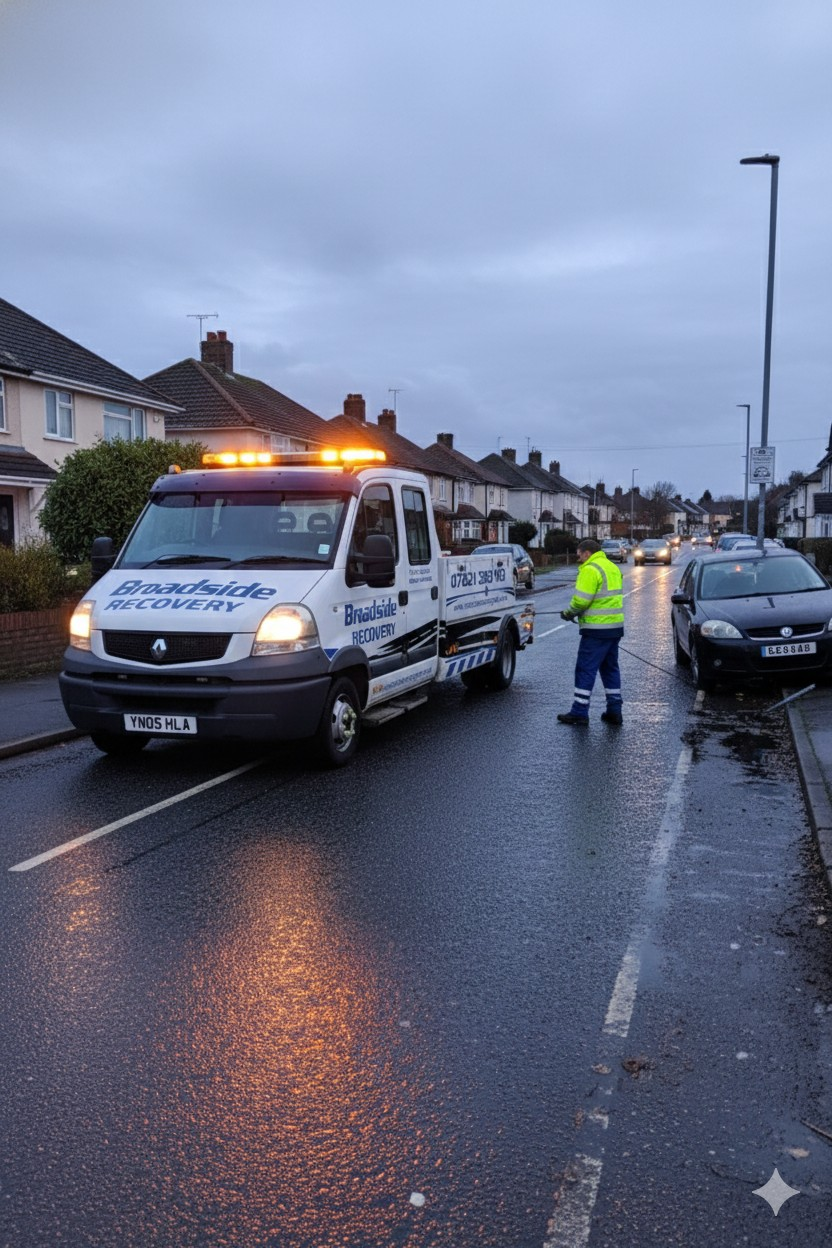
Recovering a car from flood water needs care beyond a normal breakdown — the vehicle should not be driven or started, and depending on how deep the water reached, it may need to be recovered on a flatbed without the engine running at all, then assessed before anyone tries to start it.
If you have been through standing water and are unsure whether damage has occurred, having the vehicle checked before it is driven any further is the safer option, particularly if the water reached above the sills or the engine has cut out.
Need this sorted today?
Car stalled in flood water? Don't try to restart it — call us for recovery instead.
Frequently asked questions
How deep is too deep to drive through?
As a rough guide, if water reaches anywhere near your door sills it is too deep for most ordinary cars, and if you cannot judge the depth confidently, that uncertainty is itself a reason to turn back.
Is saltwater flooding worse than rainwater flooding?
Yes — saltwater corrodes electrical connectors, wiring and metal components far faster than fresh water, so a car driven through a coastal seawater flood can suffer lasting damage even if it seemed to drive through fine at the time.
My car stalled in flood water — should I try to restart it?
No. If water may have reached the engine, restarting it risks trying to compress water inside the cylinders, which can cause serious internal damage. Leave it off and call for recovery instead.
Are fords in Cornwall safe to cross during storms?
Not reliably — levels at fords can rise quickly during heavy rain, and a crossing that was fine an hour earlier may not be safe now. Check depth markers where fitted and use an alternative route if there is any doubt.
Can Broadside Recovery collect a flooded vehicle?
Yes, we can recover a vehicle that has stalled in flood water without attempting to start it, which gives it the best chance of an economical repair once it has been assessed.
Will normal insurance cover flood damage?
Cover varies by policy and insurer, so check your specific terms; regardless of cover, getting the vehicle recovered without restarting it is the right first step if it has stalled in water.
Services covered in this guide
Related guides
Car Been in Floodwater
Water in an engine or electrics can turn a recoverable car into a write-off in seconds. The first rule is simple: do not turn the key.
ReadWinter Driving Tips for Cornwall
Cornwall's winters are mild by UK standards but still catch drivers out — cold starts, battery failure, and the odd stretch of ice or snow on higher ground.
ReadBreakdown Emergency Kit
A practical, no-nonsense list of what is actually worth carrying for a breakdown, and the rules around using it safely once you need it.
ReadWhat Happens When You Call
The full call-out sequence from first ring to drop-off, including exactly what to do while you wait at the roadside.
Read