
Four-wheel-drive vehicles and SUVs are common across Cornwall, from farm-use pickups to family SUVs that occasionally end up on a beach car park or a muddy field for an event. They are also heavier, wider and mechanically more complex than an average family car, which changes how a recovery is approached.
The main risk with an all-wheel-drive vehicle is treating it like a normal car — towing it with only two wheels off the ground, for example, can damage a transfer case or centre differential on some drivetrains. Getting the method right matters more here than on a simple front-wheel-drive hatchback.
This guide covers weight, drivetrain risk, the choice between a low-loader and a dolly, and the specific challenges of beach, field and off-road recoveries.
Weight and size
Many 4x4s and larger SUVs are noticeably heavier than a typical hatchback or saloon, and some pickup-based models push toward the upper end of what a standard car transporter can safely handle, especially loaded with tools, camping gear or a canopy.
Tell us the make and model, and whether it has a canopy, roof tent or other permanent additions, so the right truck and ramp setup is used from the start.
AWD drivetrains and why all four wheels must be off the road
Most four-wheel-drive systems mechanically link the front and rear axles in some way, whether permanently or through an electronic system. Towing the vehicle with only one axle on the ground — as a conventional two-wheel tow does — can force that link to rotate against resistance it was never designed for, risking damage to the transfer case, centre diff or driveline.
For this reason almost every 4x4 or AWD SUV should be recovered with all four wheels off the ground, which in practice means a flatbed or low-loader rather than a conventional tow truck.
- Permanent four-wheel-drive systems — flatbed only, no exceptions in most cases
- Selectable 4WD (part-time systems) — check the handbook, but flatbed is still the safer default
- All-wheel-drive SUVs with electronic torque distribution — treat the same as full 4WD
- Rear-wheel-drive-based SUVs without AWD — normal recovery rules apply
Low-loader vs dolly
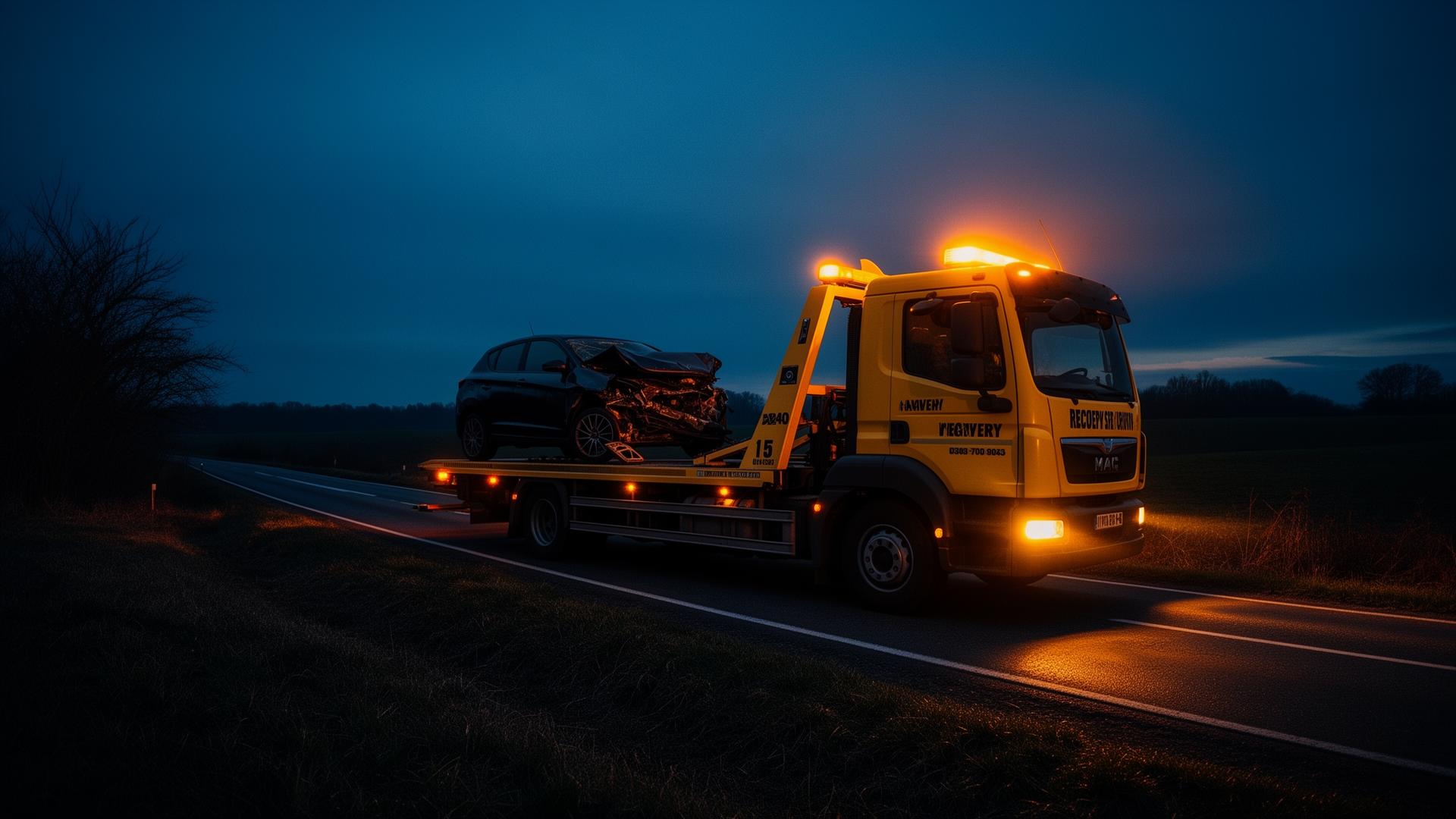
A low-loader or flatbed lifts the entire vehicle clear of the road, which is the safest option for any AWD vehicle and the only sensible choice for a heavier or wider 4x4. A dolly, which lifts just one axle onto a small trailer while the other rolls, is sometimes used for short repositioning moves, but it carries the same drivetrain risk as a conventional tow if used on the wrong vehicle.
For anything beyond a very short, low-speed move on hard standing, a full flatbed or low-loader is the correct choice for a 4x4 or SUV.
Beach and field recoveries
Cornwall's beach car parks and coastal fields catch out more vehicles than people expect, particularly around tide times and after wet weather when firm-looking sand or grass turns soft. A stuck 4x4 in these settings usually needs recovery kit rather than brute force — spinning wheels in sand or mud digs the vehicle in further and can damage the drivetrain.
If you are stuck on sand, stop trying to drive out once the wheels start spinning freely, and call for recovery rather than risking the tide or further digging the vehicle in.
- Sand recoveries need to be planned around tide times where relevant
- Waterlogged fields often need a winch pull to firm ground before the vehicle can be driven on
- Access for the recovery truck itself needs checking — not every beach or field is reachable
- Stop spinning the wheels; it usually makes extraction harder, not easier
Winching
Winching brings a stuck or embedded vehicle back to firm, drivable ground using a cable and anchor point, either from the recovery truck or a secondary anchor such as a tree or another vehicle. It is common for anything bogged down in mud, sand, or a ditch, and is usually needed before the vehicle can be loaded for onward transport.
A winch pull needs a sound anchor point on the vehicle itself — using the wrong point, such as a plastic tow eye cover or a decorative bumper feature, can cause damage or fail under load.
Towing eyes on modern SUVs
Older 4x4s often had an obvious metal recovery hook, but many modern SUVs hide the towing eye behind a small removable panel in the bumper, sometimes supplied only as a screw-in eyelet in the boot toolkit. Finding this before recovery starts saves time and avoids the wrong point being used under load.
If you know where your vehicle's towing eye or panel is, mention it when you call — it is a small detail that speeds up a winch pull considerably.
Need this sorted today?
Stuck, bogged down or broken down in a 4x4 or SUV? Call now for the right recovery method.
Frequently asked questions
Can my 4x4 be towed on two wheels?
In most cases no. Four-wheel-drive and AWD systems risk drivetrain damage if towed with only one axle on the ground, so a flatbed or low-loader carrying the whole vehicle is the safer method.
My SUV is stuck on a beach — how quickly can you get there?
We treat tidal locations as time-sensitive and will prioritise accordingly. Tell us the tide situation clearly when you call so we can plan the response.
Will winching damage my vehicle?
Not if done correctly using a proper anchor point, either a factory towing eye or a suitable chassis point. Using the wrong point is what causes damage, which is why we check before pulling.
Can you recover a 4x4 from a muddy field after an event?
Yes, this is a common job, particularly after wet weather. Let us know the ground conditions and how far the vehicle is from a hard road so we bring the right equipment.
I can't find my SUV's towing eye — does that matter?
It helps to locate it in advance, often behind a small bumper panel or in the boot toolkit, but if you cannot find it we can identify it on arrival.
Is a low-loader always used for 4x4 recovery?
It is the default and safest option for most 4x4s and AWD SUVs, though very short low-speed repositioning on hard standing occasionally allows other methods.
Services covered in this guide
Related guides
Towing an Automatic Car
Many automatics should not be towed with their driven wheels on the road. Loading onto a flatbed avoids the problem entirely.
ReadTowing Eyes & Recovery Points
Two minutes of checking before the truck arrives can prevent a bent subframe or a torn bumper.
ReadFlatbed vs Tow Truck
Why the wrong lift can damage a gearbox or bumper, and how to tell which method your vehicle actually needs before the truck arrives.
ReadRecovery in Narrow Cornish Lanes
Cornwall's lanes are the county's defining recovery challenge. Here is how a truck actually gets to you.
Read