
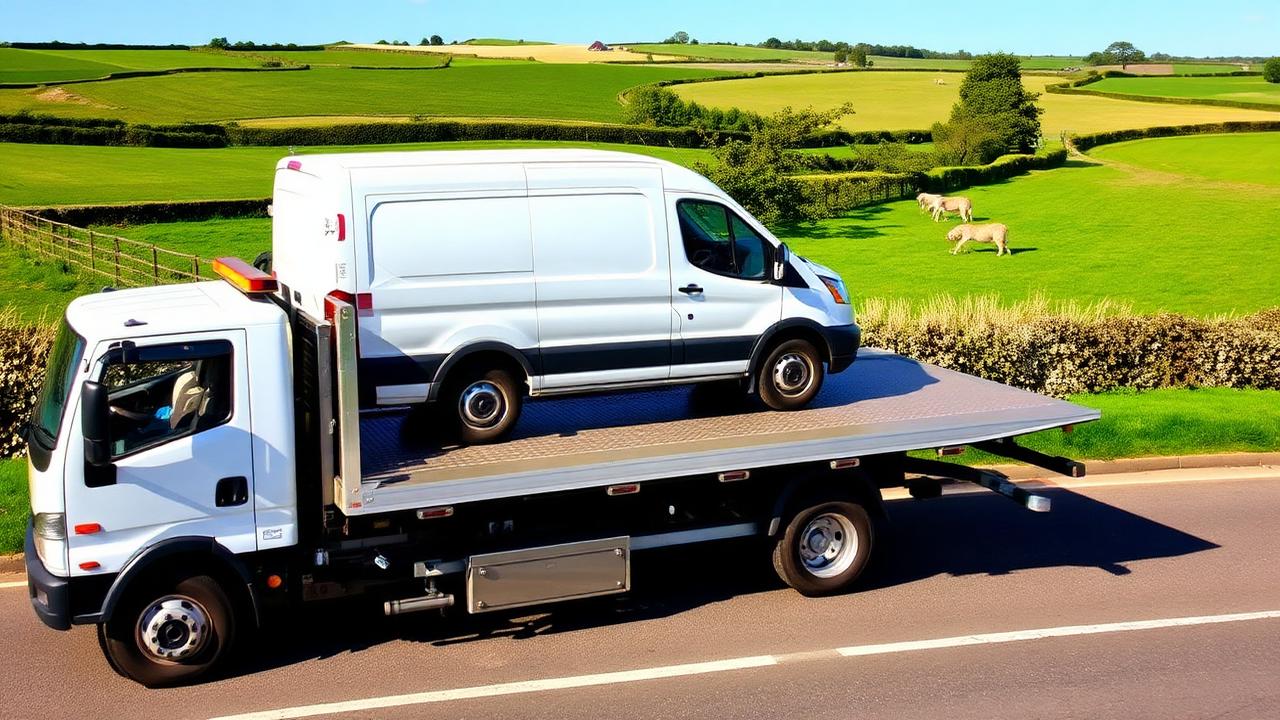
Often, no — not safely on its wheels. Many automatic gearboxes rely on the engine running to pump oil around them. If the car is towed with its driven wheels turning and the engine off, parts inside the gearbox can spin without lubrication and overheat. The safest way to move a broken-down automatic is on a flatbed with all four wheels off the road, which is how we load as standard.
The same logic applies to most four-wheel-drive cars and to every electric and hybrid vehicle. This guide explains why, what your handbook will say and what to tell the recovery driver.
Why automatics are different
In a manual car, putting the gearbox in neutral largely disconnects the wheels from the engine. In many automatics, neutral does not stop internal parts turning when the wheels turn, and lubrication depends on a pump driven by the engine. Tow the car with the engine off and the driven wheels rolling, and those parts can run dry. The damage is not always obvious straight away, which is why it catches people out.
Dual-clutch and continuously variable (CVT) gearboxes have their own restrictions, and some manufacturers forbid towing with any wheels on the road at all.
What your handbook says
Look for a section called towing, emergency towing or transporting the vehicle. Many handbooks allow only a very short, slow tow — or none — and many recommend a flatbed. If you cannot find the handbook, assume the stricter rule applies. It is much cheaper to load the car properly than to replace an automatic gearbox.
Front-wheel, rear-wheel and four-wheel drive
- Front-wheel-drive automatic: lifting only the front wheels is sometimes permitted by the maker, but a flatbed removes all doubt.
- Rear-wheel-drive automatic: the driven wheels are at the back, so lifting the front does nothing to protect the gearbox.
- Four-wheel or all-wheel drive: all four wheels are connected to the drivetrain, so any wheels on the road can cause damage. Flatbed only.
- Electric and hybrid: motors are connected to the wheels and can generate power when turned. Flatbed only.
Why a rope or a friend's car is a bad idea
Aside from the gearbox risk, towing on a rope or pole needs a driver in the towed car, working brakes and steering, and a lot of concentration from both drivers. With the engine off, power steering and brake assistance are much heavier than normal. On Cornwall's narrow lanes and fast A-roads that is a real hazard. If an automatic will not drive, load it.
What happens when we recover an automatic
The driver loads the car onto the flatbed so no wheels are turning on the road. If the car is stuck in park and will not roll — a common result of a flat battery or electrical fault in some automatics — the driver can use skates, dollies or the winch, or may be able to release the gearbox using the manufacturer's method. Once it is secured, it goes to the garage, your home or wherever you choose, with you travelling in the cab.
When you call, tell us it is an automatic, whether it is two- or four-wheel drive if you know, and whether it will come out of park. That lets us plan the loading before we arrive.
If it is just a flat battery
Plenty of automatics that will not start simply have a flat battery. A jump start or a battery swap at the roadside may be all it needs, and the car can then be driven normally. If the car starts but shows a gearbox warning, or will not select drive, do not force it — that is a sign it needs to be moved rather than driven.
Need this sorted today?
Automatic, four-wheel drive or electric car broken down? Tell us when you call and we will load it on the flatbed, with the price agreed before we set off.
Frequently asked questions
Can I tow my automatic in neutral?
Often not safely. In many automatics, neutral does not stop parts in the gearbox turning, and without the engine running they may not be lubricated. Check the handbook, and use a flatbed if in doubt.
My automatic is stuck in park. Can you still move it?
Usually, yes. The driver can use skates, dollies or the winch, or release the gearbox using the manufacturer's method where possible, then load it onto the flatbed.
Do you tow automatics on their wheels?
We load on a flatbed as standard, with all four wheels off the road, which avoids the gearbox risk.
What about four-wheel-drive and electric cars?
Both should travel with all four wheels off the road. Four-wheel drives and electric and hybrid vehicles always go on the flatbed.
Could it just be the battery?
It could. Flat batteries are a common reason an automatic will not start, and a roadside jump start may be enough. If a gearbox warning appears afterwards, do not drive it.
Services covered in this guide
Related guides
Flatbed vs Tow Truck
Why the wrong lift can damage a gearbox or bumper, and how to tell which method your vehicle actually needs before the truck arrives.
ReadTowing a Car: Rope, Bar or Flatbed?
A tow rope in the boot looks like a cheap fix. Sometimes it is; often it is the start of a bigger problem. Here is an honest comparison.
Read4x4 and SUV Recovery
Why four-wheel-drive vehicles need particular handling during recovery, and what changes when the vehicle is stuck on a beach, field or verge rather than a road.
ReadElectric Vehicle Recovery
EVs cannot be conventionally towed. Here is why, plus what to do if you run flat between chargers in Cornwall.
Read