
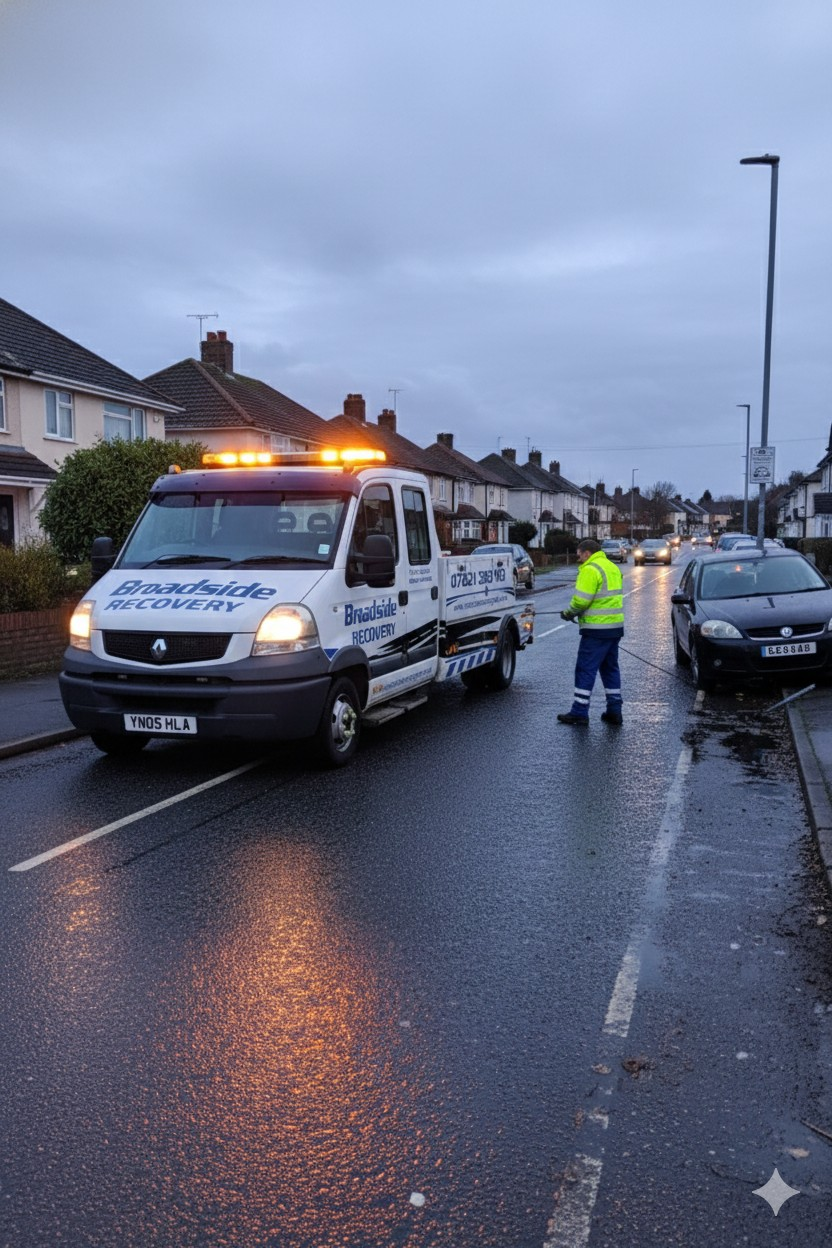
If a warning light, noise or loss of power gives you enough time to reach a service area or lay-by, stop there rather than testing whether the vehicle will make the next town. You are away from the live carriageway, but you still need to think about passing vehicles, visibility and whether a recovery truck can reach the vehicle safely.
Call Broadside Recovery on 07874 130193 and give us the name of the services or the closest road and junction, your direction of travel and where you are parked. We cover Cornwall 24 hours a day, work with cars, vans, motorcycles, motorhomes and light trucks up to 7.5 tonnes, and agree the price before dispatch.
First decide whether the stopping place is suitable
A marked parking bay at a service area normally gives more separation from moving road traffic than a roadside lay-by. If the vehicle still moves normally and no warning tells you to stop immediately, use an ordinary bay with enough open space around it. Do not block the entrance, exit, fuel pumps or a route used by larger vehicles.
A lay-by needs a different check. Pull completely into the available space, switch on the hazard lights and look at the approach from behind. A short bay, poor lighting or a bend can make a stationary vehicle difficult to see. Move yourself and any passengers away from the traffic edge while you make the call. If the vehicle is in a dangerous position or anyone is at immediate risk, call the emergency services first.
Tell us exactly which stop you have reached
A place name by itself may not identify the right side of a major road. Start with the road number, then say whether you were travelling east, west, north or south. Add the last junction, roundabout or signed destination you passed. At a service area, give its displayed name and describe the part of the site you are in, such as the car park rather than the fuel forecourt.
In an unsigned lay-by, send a dropped map pin or what3words location if you can. Tell us what is beside you: a picnic area, a bus stop, a junction sign or a view of the opposite carriageway can all help confirm the position. Keep your phone available because the driver may call when close to the entrance.
- Road name or number and direction of travel
- Name shown on the services sign, if there is one
- Last junction or signed place you passed
- A map pin, what3words location or postcode
- The vehicle type and whether it starts, rolls, steers and brakes
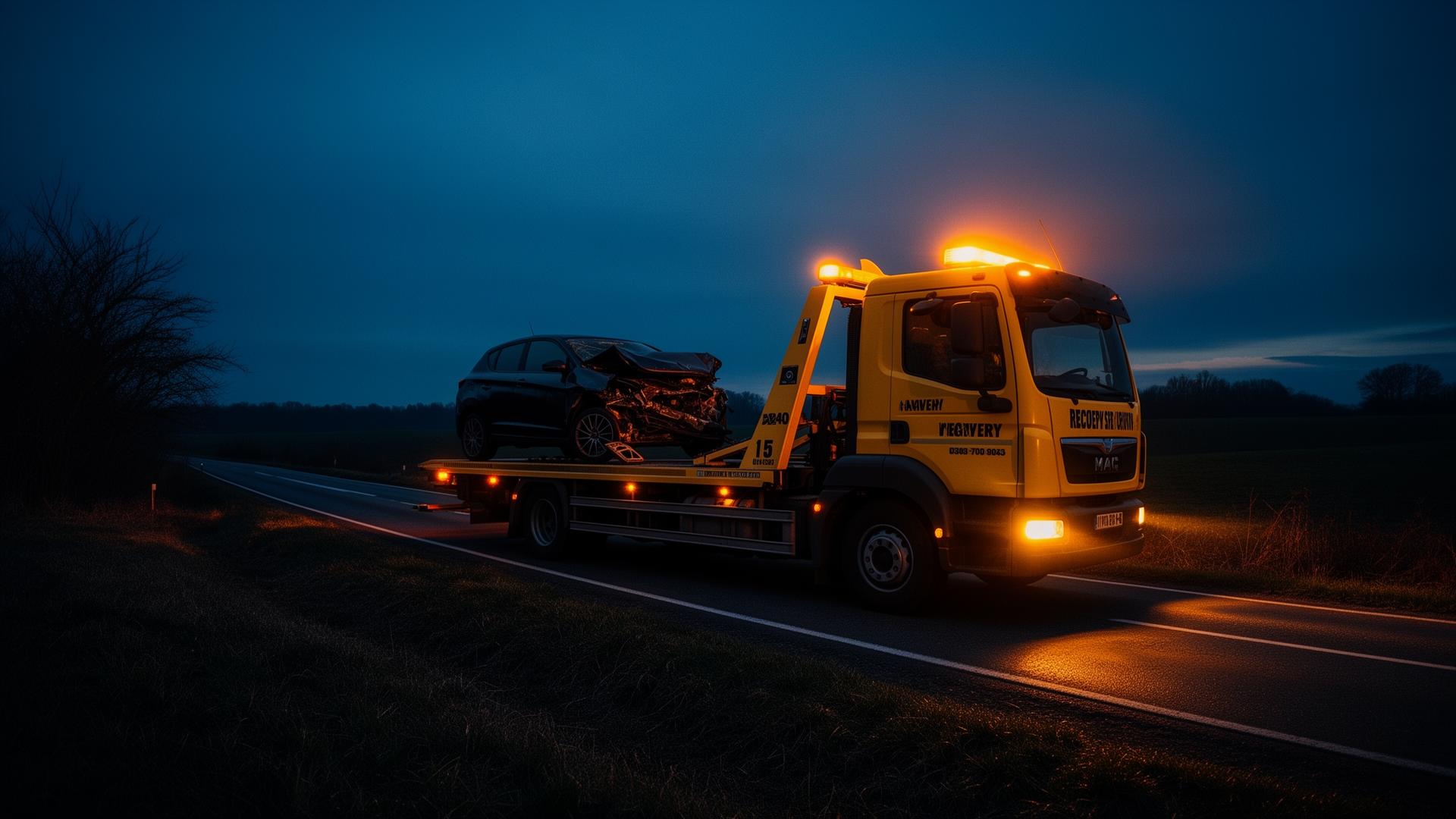
Waiting at services
If you are in a proper parking bay, wait somewhere that keeps children and pets away from the circulation lanes. Take the keys and valuables with you if you leave the vehicle. Let us know if a height barrier, one-way system or tightly parked vehicles could affect access to the bay; that information helps us plan where the truck should enter and turn.
A vehicle that has overheated should stay switched off. Do not open a hot cooling system. If you stopped because of a tyre problem, do not attempt a wheel change where vehicles are passing close to the affected side. A battery fault, fuel issue or usable spare tyre may be suitable for roadside assistance, but only where there is room to work safely. Otherwise, loading the vehicle and dealing with it elsewhere is the safer option.
Waiting in a rural lay-by
Many Cornish lay-bys have no shelter, lighting or facilities. Make yourself visible without standing next to the traffic lane, and keep everyone together in a position where approaching vehicles are not directed towards them. At night, use a torch when moving around but avoid dazzling drivers. In poor weather, tell us if the surface is soft, flooded or sloping because that can affect how the truck positions for loading.
Do not walk along a fast road to look for fuel or phone signal. If reception is intermittent, send the location message while you have a connection and stay near the vehicle in a safe place. For a complete live-carriageway or hard-shoulder safety sequence, use our motorway breakdown safety guide; this page assumes you have already reached a stopping area away from the running lane.
What happens when the recovery truck arrives
The driver first checks the space, surface and traffic flow. In a service-area bay, nearby parked cars or a one-way aisle may mean the vehicle has to be moved a short distance before the bed can line up. In a lay-by, the truck needs enough length to stop, lower the bed and leave again without reversing into moving traffic.
Tell us before arrival if the wheels are locked, the steering does not move, there are no keys or the vehicle is heavily loaded. Those details affect the loading equipment and, for a van or light truck, which recovery vehicle is suitable. Motorcycles need their own securing method, so identify a bike on the first call rather than describing it simply as a vehicle.
Where the vehicle can go
You can choose an agreed garage, home, accommodation or another suitable address. If the garage is closed, check whether it accepts vehicles or keys out of hours before asking us to take the vehicle there. A vehicle that is safely parked and does not need moving immediately may also be suitable for a planned transport booking rather than an emergency dispatch.
For road-specific information, see the A30 and A38 recovery pages. If you have stopped before reaching a lay-by and are still exposed to traffic, use the fast-road safety guidance instead. If the problem is a flat battery, tyre or fuel shortage, our roadside guides explain when an on-the-spot attempt is sensible and when recovery is the better choice.
Need this sorted today?
Stopped at services or in a lay-by? Send the exact location and direction of travel, then call for a price before dispatch.
Frequently asked questions
What location should I send from an unsigned lay-by?
Send a dropped map pin or what3words location, then add the road number, direction of travel and the last junction or sign you passed. That distinguishes one side of the road from the other.
Can you load a vehicle from a busy service-area car park?
Usually, yes. Tell us which part of the site you are in and mention barriers, tight rows or one-way access so the driver can plan the approach.
Should I try to change a wheel in the lay-by?
Only if there is generous separation from traffic and you can work entirely inside the bay. If vehicles would pass close to you, do not kneel beside the road; tell us the tyre position and we can discuss assistance or recovery.
Can you collect a van or motorcycle from the same stopping places?
Yes. We recover vans, motorcycles and other supported vehicles, but the equipment differs. Give the exact vehicle type, dimensions or load details when you call.
Do I need breakdown membership to call?
No. Broadside Recovery works directly with drivers. We ask for the location, vehicle, problem and destination, then agree the price before dispatch.
Services covered in this guide
Related guides
Motorway Breakdown Safety
The correct sequence for breaking down on the M5, A30 or A38 — getting clear of the carriageway, using the SOS phones, and what to tell the operator.
ReadBroken Down on the A30
The A30 is the county's spine and its fastest road. Here is the safe sequence if you stop on it.
ReadRecovery in Narrow Cornish Lanes
Cornwall's lanes are the county's defining recovery challenge. Here is how a truck actually gets to you.
ReadWhat Happens When You Call
The full call-out sequence from first ring to drop-off, including exactly what to do while you wait at the roadside.
Read